Thursday, March 6, 2014

Cafe Le Whore makes the Small Press Distribution's Best Seller list for January/February 2014

Hearty thanks to friends, relatives, literature lovers, serious readers, neighbors, colleagues and perfect strangers to making this happen. Though making any list is not important to me, what is is being read and taken seriously by those whom I admire, both readers and writers. Thanks!

Here's the list:

SPD Fiction Bestsellers

January & February 2014

Monday, February 3, 2014

Anu Kumar reviews the works of Moazzam Sheikh


Moazzam Sheikh’s love affair with the short story

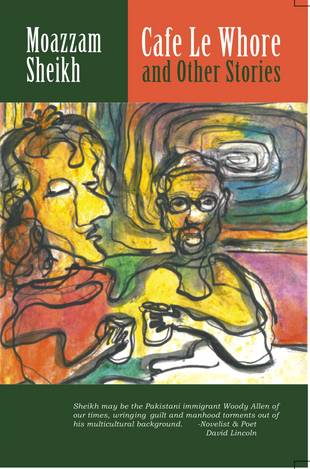
cafe le whoreThe cover of Cafe Le Whore and other Stories, Moazzam Sheikh’s new collection, his second one, appears to evoke the lead story. It is replete with bright haunting colours but still strikes an elusive tone, almost like the narrator’s repeated encounters with his dead mother in a city cafe and his later frustrated search for her, intertwined with his meetings with a down and out whore.
The story strikes in places a hysteric fun pitch, that makes it a racy read but then you come up short against a certain melancholy tone which is what this story leaves you with.
***
Moazzam_Letter_from_India_A short story for the most part has a lineage, not in just what it says but even in how it is written, and because an explanation for why I wrote a blurb for this intriguing, wonderful and hard to place collection must be convincing, it must begin with some of Moazzam Sheikh’s translated stories in A Letter from India (Penguin 2004).
Moazzam’s introduction for this earlier collection talked of his efforts searching for contemporary short stories from Pakistan and how surprisingly difficult it turned out to be. As these stories show, there is a rich heritage of stories, not merely in Punjabi and Urdu, but in other languages, other locales and by writers, largely forgotten but skilled craftsmen of the form. The collection included many voices unfamiliar to the Anglophone reader, and Moazzam’s journey was in quest of a literature, that existed in different languages and dialects from regions even marginalized, most of which had long remained hidden or was ignored; it was also an attempt to show the different narratives that are possible, even within the short story.
Perhaps the lead story, ‘A Letter from India’ is an apt title for the book too, for despite the divisive politics that created two countries of one, homes and hearts are always hard to divide; languages and a shared history will persist across . . .

Saturday, January 25, 2014

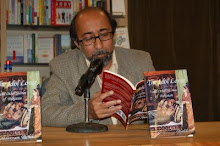
My reading at Green Apple Bookstore

My reading at the legendary Green Apple bookstore in the Inner Richmond neighborhood went really well. It was held in Granny Smith Room. It's a narrow, longish, cozy place, so with 20+ people it gave the feeling of a packed room. In attendance were mostly friends and neighbors, writers such as James Warner and Sarita Sarvate, translators such as Peter Frentzel, poet Cesar Love, and musicians Patrick O'Maley and Sean Barnett. My editor friend Robynne Weaver and close friends like Nikki Bengal, Ramon Calhoun, Ijaz Syed, Jim Torrens and Galina graced the occasion. My boy Amar and Galina's son Lev entertained themselves with books in the humor section downstairs, and my lovely wife Amna and our younger son Arman flitted in and out of the Granny Smith Room. At one point I spotted Arman in Ijaz Syed's lap.

I thanked those who had made the time to come and hear me read from my new collection Cafe Le Whore and Other Stories, silently missing those who couldn't come, many due to parental duties, a few due to non-parental commitments.
Before I began to read from the first story in the collection, I talked a little about the story since it was the first story I ever wrote, its humor, its light-hearteness, how it had acquired layers upon layers over the years, loss of early innocence of the tone, its debt to Salinger.
I finished the story by pointing out that despite its humor and mild sarcastic tone, the story does get a bit blue towards the end.
The next story I read was one of my favorites in the collection, Film Librarian. I explained to the audience due to my connection with libraries I had always wanted to write a story that took place inside and around this wonderful institution as an homage to those who give their best years to serving the cause of knowledge and imagination, not to forget their unconditional attention to those whom no one wants in our society, including, in some cases, their own families.
Film Librarian deals with a homeless old lady and a book she must possess all the time, a film book that has a movie still of an 'unidentified' female actor sitting at a bar with two known male actors. The old lady wants to know the name of the actress. The librarian has her work cut out for her, as the actress has disappeared without a trace. The librarian's own life is about to take a complicated turn, for better or worse as she finds herself caught between two lovers, one a filmmaker, the other a novelist.
Finally, I read from the title story Cafe Le Whore. I talked a little about the story and what triggered the imagination to produce it. Many readers have confided to me that Cafe Le Whore is my best work so far. Only time will tell. I am glad to have written it and I thank you for reading it. 
No reading is complete without the Q&A session. The questions included issues about projecting personal problems into the stories and coming out with solutions, attempting supernatural as in the case of Cafe Le Whore where the mother of the protagonist has come back from the dead as an out/miscast and is living in the grungy neighborhood of Tenderloin district of San Francisco.
There was a comment ( a subtle question) about how my writing has moved away from what is generally perceived as typical of South Asian writing in America.I explained that that was a conscious effort as I felt that many South Asian writers fall into the market trap and write what the agents/editors and general readership expect of their writing. I would like to belong to a group of South Asian writers who have made America their home, for better or worse, and would like to impose a lens on the issues which affect us and our children here, and of course the larger world.
It's always gratifying to see friends and readers lining up with your book in hand for an autograph and intimate conversation.
Before I walked out, I thanked the wonderful crew of the store, especially Ashley and Danielle. The world of the independent bookstores is a complicated one. The partnership between the independent writer, the independent publisher and the independent bookstore is not a natural one. The key factor is the readership which is still being influenced by the media. So when a person decides to support an independent bookstore and walks in to buy a book, it is usually to buy what has been reviewed in a major newspaper or an established source. Rarely do the local newspapers of a major city bother to review local, independent writers whose writing aims for something away from the highway 101.
So when an independent bookstore goes out of its way to promote a local writer, it is in the true spirit of what literature is all about, offering an alternative, encouraging people to hear a different voice.

Monday, December 23, 2013

Comments about Cafe Le Whore and Other Stories

Encouraging comments by Professor Karen Leonard (UC Irvine) about my book.


What a package of diverse pleasures Moazzam's new collection of short stories proves to be! Cafe Le Whore is the title (well, OK, if I didn't like that story best of all I might have expressed hesitation about the title), and the range of settings and characters is so impressive. From rural Punjab to urban Lahore and San Francisco, Moazzam writes masterfully of personalities and contexts; here and there one glimpses Moazzam himself, tantalizing and deftly presented. Sex in the present, sex in the past, women's lives, men's lives, memories recaptured or lost...these are his themes, his obsessions. Very rewarding reading.

Comment posted by Dr. Omar Ali at Amazon page of Cafe Le Whore:
It works because Moazzam is not interested in writing "Pakistani" fiction or "Western" fiction. Just stories, about people, in strange places, sometimes doing strange things, but always human, all too human . . . Funny too. Very funny at places.

Thursday, December 12, 2013

Amar's prose and poetry!

Some of you already know of Amar's role in assisting Amna and Javed create the cover of my book. But this side of him is a lesser known . . . until now!

Amar first heavy metal rock lyrics!

Amar's stab at fiction a couple of years ago

Tuesday, October 8, 2013

Kind words of praise trickle in for my upcoming collection Cafe Le Whore and Other Stories.


Read *Cafe Le Whore and Other Stories* for a magic carpet ride . . . Sheikh may be the Pakistani immigrant Woody Allen of our times, wringing guilt and manhood torments out of his multicultural backdrops. (Indeed, Woody Allen gets a wink in the title story.) Sheikh's consciousness of style sometimes drives things to the point that he throws words at the page a-la Jackson Pollack - it's worth it, especially as the syntax becomes more of an illustration of the kinds of challenges and barriers the characters must confront. Most readers will find this is a great collection to take on the plane or the subway, or just to sit around the house and read. These stories will relieve your inner tension and add a little spice to your diet.                
 - David Lincoln                                                                                  
 
For Moazzam Sheikh the human, the political, and the sexual are inseparable. In these ten delicately nuanced stories, full of humor and pathos, Sheikh pushes the limits of language and our understanding of the world. His stories offer a poignant meditation on our place, or the lack of, in the new global reality. 

- Balaji Venkateswaran
An extraordinary collection of tales by a Pakistani writer. Moazzam Shaikh’s stories are not confined to a ‘tradition’, but are refreshingly modern in tone and sensibility as they range over a wide range of locales and themes.                           
-Khademul Islam
The stories in Café LeWhore are many marvelous things, but they are always ghost stories.  Ghost stories full of life.  Stories about the places that once were, but are lost to a flood, or an infidelity.  There are ghosts of difficult mothers and kings of Bollywood and Punjabi gypsies.  There are surprises in every story—and in every sentence, because Moazzam Sheikh is the rare storyteller, who knows that it is, in fact, as important that a writer tell as it is for the writer to show.                                                                
-  Brian D Bouldrey

Best of east, written in west. Moazzam  Sheikh's stories are absolute gems, a pleasure to read; he packs more details and depth in a short story than a novel by Rushdie. Lost in east, lost in west, sad and lonely, they resonate, echo and shadow what one has lived and what one has left behind.                                 
 -  Syed Afzal Haider

 Moazzam Sheikh's new collection reveals the amazing possibilities of the short story.  His stories encompass a range,  traversing borders and modes of telling, evident even within a single story.  There are diary entries meshed within narratives,  dreams alternating with soliloquies,  and musings that tell you that the mind exists in its own rich maze of stories. Then there are stories within stories, blending the 'unreal' with the imagined,  past and present. There are stories set in Pakistan and also in America,  but all these touch insistently on the lone voice of the individual,  rich with longings, wants and desires; the confusions evident in a seemingly crowded life,  but always in the end, very alone. Especially in stories speckled with humour and as diverse as 'The Mourner', 'Rose'. 'Aunty Nimmy' and 'Film Librarian', it is the pathos that lingers, hauntingly always.
 -  Anu Kumar

Cafe Le Whore is due in late October. More information to follow. Stay tuned!

Cafe Le Whore and Other Stories can be purchased at Small Press Distribution

Sunday, October 7, 2012


From Idleness to Determination

A dear friend visited us recently and brought me a book she had bought in India. Although everyone was intrigued by the title, it was the author's name that caught everyone's attention. Where have we seen the name Saeed Mirza? We asked each other since it seemed familiar but neither could pin it down for the  context in which it appeared, threw us off. The novel, Ammi: letter to a democratic mother, is the writer's debut novel, and originally written in English. A brief description suggested it was a “magical tale of love and romance to a personal testimony of growing up in India to a discourse between history and politics that presses into service Mulla Nasruddin, Studs Terkel, Ibn Senna, Eklavaya and Ra'abia Basri. The post- modern and post-colonial in me was hooked. The shocker, however, came in the next paragraph confirming the author was indeed one of the pioneers of the Hindi Art Cinema. Or as the book stressed “a pioneer of the New Wave, progressive cinema in India” even if his first film was made some twenty years after Ritwik Ghatak's Ajantrik. A question that nags many of us who write in English raised its head: why would a person so quintessential to the Hindi art cinema opt for English as a medium of expression for writing a novel, not a popular but literary one? Would Antonioni or Kurosawa write his first novel in English?

   At a different time, the whole issue would not have taken up so much of my peace of mind if for the fact that another friend, a fine writer in her own right, had not emailed a link to an article written by another fine writer from Pakistan. The article by Mohammad Hanif was published in an English publication titled Tehelka. It is a good article that raises the same interesting question and the author's humor is appreciated. In a lucid manner he explains why he writes in English by drawing attention to the socio-politico-economic situation in which he grew up, and most Pakistanis continue to do still. I have talked about the continuing tragedy in Pakistan of not paying attention to and doing something about making local languages the medium of instruction. I may have also written about how most Pakistanis grow up and/or reach college education through a two-tier process of self-devaluation. Since it is not a conscious process, most of us don't realize when and how we insult ourselves. Hanif Mohammad succinctly sums up when he says, “When I was growing up in Pakistan, the complete inability to read or write in your mother tongue was a prerequisite for upward mobility.”

Likewise, I have witnessed family friends proclaiming that a Punjabi speaker can never pronounce the urdu word “hai”  correctly. He's bound to pronounce it with the tinge of a cow's mooo! Similarly, I once heard another family friend, a graduate from the prestigious St. Anthony's High School in Lahore, making fun of his brother-in-law, who belonged to a lower economic station, in the company of his friends as the brother-in-law habitually mispronounced, with an Urdu-inflection, the name of the then very popular, imported cigarette brand among youngsters.

Yet Mohammad Hanif confuses the issues of lack of education in ones mother tongue due to our leadership's shortsightedness and servile attitude, and why one does or should choose to writer in a language. Although he rightly points out that there was no college physics in Urdu, he doesn't engage with the question of its absence when there indeed was an Urdu physics for 10th grade. If authorities can produce physics books prepared for Urdu medium high schools, why can't they do the same for college level? Even that discussion is secondary and is often like beating a dead horse. My contention is with his answer to why he writes in English. Before I go any further I would like to present my own case of why I predominantly write in English, both fiction and non-fiction. This is what I stated in my previous article The Misshapen Twin published in this newspaper on May 27, 2012:  As for me, since I make my physical and emotional home in the US, English is the language I primarily write in and translate into. I am emotionally closer to the literary community I interact with on daily basis.”

Hanif Mohammad's response is multi-faceted. He writes in English, he says, because he “thinks and plots” and has read great literature in English and since Graham Greene, too, wrote his novels in that language. There is logic in there somewhere but I'll leave it to the reader to go hunting for it. He adds, “when I write a political rant or a comment piece, I lean towards Urdu because there are all these ready-made historical references, street slang and wordplay bursting to be put to use.” Fair enough, but it gets better, for he admits that if he's pissed, he is more likely to curse in his mother tongue. This hints at the intimacy and devaluation of the mother tongue the he and I have touched on, albeit, in different vocabularies. More interestingly, this reminds me of an exchange between Tagore and the noted actor Balraj Sahni, who switched from writing in Hindi to Punjabi. When inquired why Balraj Sahni didn't write in his mother tongue, one of the reasons he gave to the great poet was that Punjabi was not only a provincial language but a backward one too, not even a language, rather a dialect of Hindi. To which the poet replied that a language couldn't be called backward or incompetent when a poet like Nanak had written in it. He went on to recite Nanak in Punjabi. Balraj Sahni shot back that that's religious literature, and the Punjabi language lacked vocabulary for modern secular literature. Tagore then reminded Balraj that there was a time when Bengali too was perceived in such light by the educated Bengalis. That Bankim Chatterji and he have given their language thousands of new words. And that they have put their language on the world map and is mo more inferior to any other language.

The experiment of colonialism gave us an era of discontinuity, cutting most South Asians from their native traditions and literature. Its effect persists in making things worse for the coming generations. Its flow cannot be stemmed through laziness or by procrastination. If it bothers a writer that he or she does not or could not write in Punjabi, then effort has to be made, inertia  has to be overcome. If one can easily curse in ones mother tongue, then with effort and a little help from friends one can write in her mother tongue as well. The intellectual laziness and literary/artistic disconnect are but two sides of the same coin. On my last trip to Pakistan I was fortunate to fly beside a teenage Aitchisonian who was a great grandson of one of our ex-Prim Ministers. I was horrified to learn during our frank discussion about politics and literature that the young man had no idea who Waheed Murad was! No idea about Sultan Rahi! And the list went on. To be honest, I had never thought of the disconnect in those terms. I was ready to accept that those who are fortunate enough to afford and care to read literature would know of Western writers at the cost of their own or from neighborly regions. I was willing to admit such divorce makes one ill-informed about ones own literary heritage, thus distorting in the process understanding ones own historical narratives. But I had never imagined that this parting of ways could blind one to icons of ones modern history. 

Recently, as I brought up the subject in a different context, a close relative described it as only a result of “generation gap”. The sound of her argument had a ring of reason and I was humbled. But the disquiet wouldn't recede. It slowly began to seem that the ring of reason was hollow because I wondered and asked myself: Why did I know  of K. L. Segol or Najamul Hasan? How did I know that the latter eloped with Devika Rani? How do the Americans know who Chaplin and D. W. Griffith are? Why do we know who Bulleh Shah is? Why do we remember Amrita Pretam and the Spanish speakers reminisce about Borges? Two young nieces of my wife recently asked me of my views about movies belonging to the golden age of Hollywood which I thought were more like orientalist crap strengthened my point. How come our kids can know about Humphrey Bogart but not about Sultan Rahi? The answer to this conundrum lies in education which our schools, parents, and other outlets in society impart to a child. If that youngster did not know his cultural history, it is not, I suggest, simply a matter of generational gap, but of disconnect and laziness that the government and family have facilitated. And it is the same malaise that Hanif Mohammad has hinted at. I have read enough articles written by Hanif Mohammad to know that he has read and is aware of Najm Hosain Syed's poetry in Punjabi. I also know that he has read Nadir Ali's short stories in Punjabi which - according to a common friend - he enjoyed. I believe he can graduate from simply cursing in his mother tongue to actually writing literature in Punjabi. That is if would like to go beyond cursing. It won't be easy as it never is. But the process will great peace to his heart. Whereas cursing is concerned, what better advice than one parted by Caliban:

You taught me language, and my profit on ’t
Is I know how to curse. The red plague rid you
For learning me your language!


Moazzm Sheikh is the author of The Idol Lover and Other Stories (Ithuriel Press)
p.s. a shorter version of this piece appeared in News International's Literati section.